

A Collaborative Model of Integrative Preconception Care in Complex Autoimmune Infertility
Presented at the Australian College of Nutritional and Environmental Medicine (ACNEM) Conference July 2026 and the Fertility Society of Australia and New Zealand (FSANZ) Conference August 2026.
At Fertile Ground, we’ve always believed that the best care happens when healthcare professionals work together.
Over the past 25 years we’ve had the privilege of collaborating with hundreds of fertility specialists, GPs, obstetricians, surgeons, endocrinologists, psychiatrists, counsellors and psychologists, acupuncturists, massage therapists, osteopaths and other allied health practitioners, each bringing their own expertise to help individuals and couples navigate what can be one of the most challenging seasons of their lives – trying to conceive.
This clinical case study represents one of those collaborations.
About this case
This clinical case study was presented by Charmaine Dennis, Director and Senior Fertility Naturopath at Fertile Ground Health Group, and Dr Sascha Edelstein, Fertility Specialist and Managing Director of Thrive Fertility, at both the Australian College of Nutritional and Environmental Medicine (ACNEM) Conference and the Fertility Society of Australia and New Zealand (FSANZ) Conference in 2026.
While we were incredibly grateful to ultimately celebrate the birth of a healthy baby, that isn’t why we chose to present this case.
We presented it because it demonstrates something we believe is just as important: what can happen when healthcare professionals communicate openly, respect one another’s expertise and work together to build a truly integrated plan of care around the couple sitting in front of them.
Infertility is rarely simple. For many couples, there isn’t one diagnosis, one treatment or one practitioner holding all the answers. Medical history, nutrition, lifestyle, immune function, metabolic health, environmental exposures, reproductive health and emotional wellbeing all contribute to the environment in which conception is being asked to happen.
Following four unsuccessful IVF cycles, this couple paused treatment to comprehensively optimise both partners before commencing their fifth cycle. The result was a genuinely collaborative model of care.
A partnership we’re proud of
One of the greatest privileges of working in fertility care is collaborating with healthcare professionals who are genuinely committed to achieving the best possible outcomes for their patients.
Working alongside Dr Sascha Edelstein and the team at Thrive Fertility throughout this case was a wonderful example of that philosophy in action. Their openness to collaboration, evidence-informed practice and willingness to communicate throughout the patient’s journey created an environment where medical and complementary care could genuinely support one another.
This partnership reflects the way we believe integrative fertility care should be practised – not as competing disciplines, but as complementary areas of expertise working together in the best interests of the people we care for.
We hope this case encourages more conversations between fertility specialists, GPs, naturopaths, acupuncturists and allied health practitioners. Not because one profession has all the answers, but because patients deserve the benefit of every perspective working together.
This case contributes to the growing discussion around integrative fertility care, IVF support, preconception care, recurrent IVF failure and multidisciplinary fertility treatment.
Finally, we would like to sincerely thank our patients for generously allowing us to share their story. We hope it contributes to ongoing learning, stronger collaboration and, ultimately, better care for people navigating infertility.
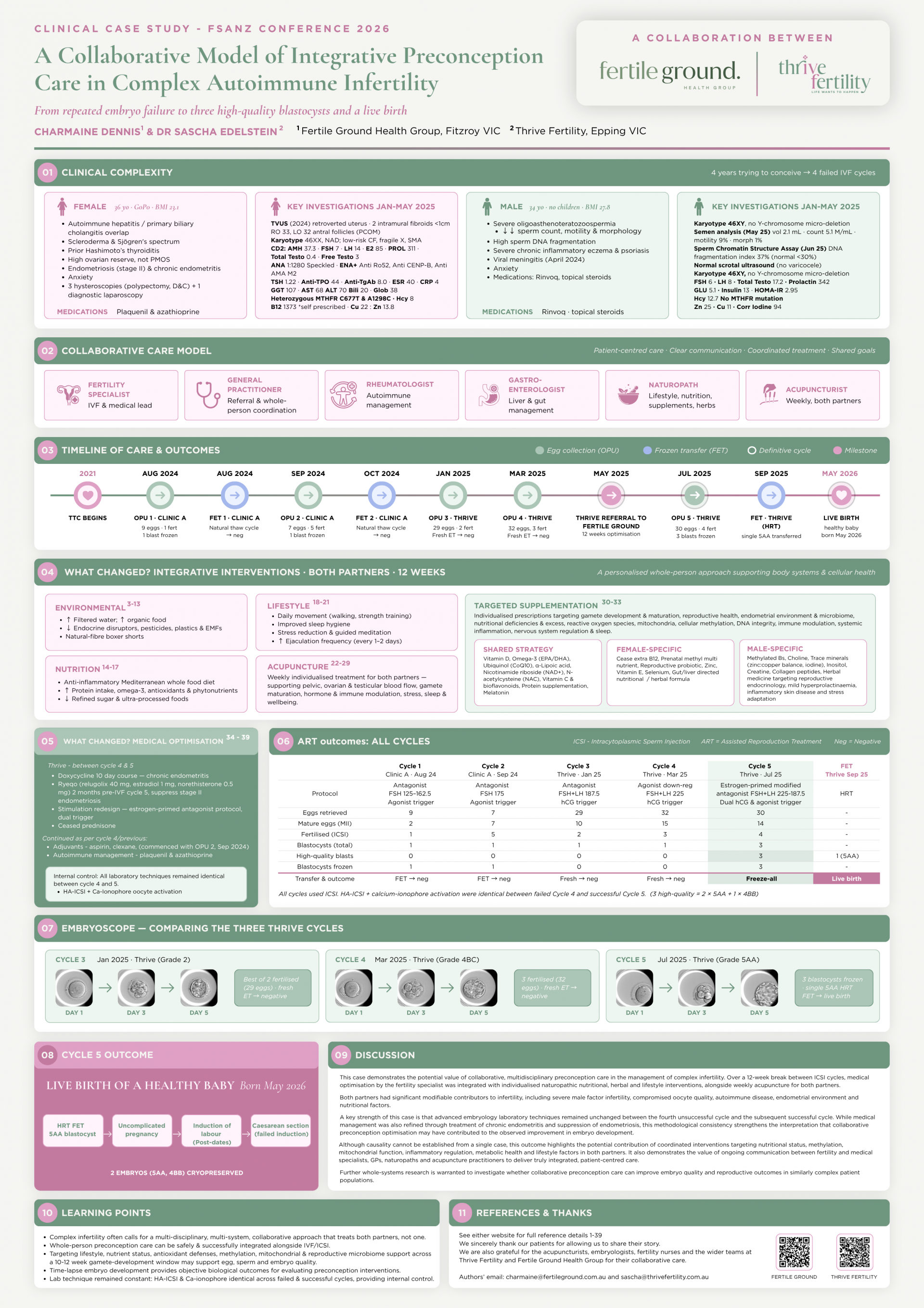
A Collaborative Model of Integrative Preconception Care in Complex Autoimmune Infertility
Presenter contact information
For further information about our case study, Fertile Ground Health Group or Thrive Fertility please contact:
1. Charmaine Dennis, Fertile Ground Health Group
- BHSc (Nat), PG Cert Repro Med
- Director | Naturopath
- www.fertileground.com.au
- email: charmaine@fertileground.com.au
- P: 03 9419 9988
2. Dr Sascha Edelstein Thrive Fertility
- MBChB, MPhil Science, MMed Ob & Gyn, Cert Repro Med, MPhil Repro Med
- Fertility Specialist | Managing Director
- www.thrivefertility.com.au
- email: sascha@thrivefertility.com.au
- P: 03 9124 3896
References
Environmental
3. Haimbaugh A, Meyer DN, Connell ML, Blount-Pacheco J, Tolofari D, Gonzalez G, Banerjee D, Norton J, Miller CJ, Baker TR. Environmental Exposure to Per- and Polyfluorylalkyl Substances (PFASs) and Reproductive Outcomes in the General Population: A Systematic Review of Epidemiological Studies. Int J Environ Res Public Health. 2024 Dec 2;21(12):1615. doi: 10.3390/ijerph21121615.
4. Parent AS et al. Endocrine-disrupting chemicals and female reproductive health: a growing concern. Nat Rev Endocrinol 2025; 21 (10): 593-607
5. Shen J et al. Exposure of women undergoing in vitro fertilisation to per- and polyfluoroalkyl substances: evidence on negative effects on fertilisation and high-quality embryos. Environ Pollut. 2024;359:124474. doi.org/10.1016/j.envpol.2024.124474
6. Defends G et al. The impact of chemical pollution and warming on male fertility: a narrative review by the Special Interest Group “Environment and Fertility” of the Italian Society of Fertility and Sterility and Reproductive Medicine (SIFES-MR). J Assist Reprod Genet 2025; 42 (12): 4071-4101
7. Green MP, Harvey AJ, Finger BJ, Tarulli GA. Endocrine disrupting chemicals: Impacts on human fertility and fecundity during the peri-conception period. Environ Res. 2021 Mar;194:110694. doi: 10.1016/j.envres.2020.110694.
8. Kumar, N., Singh, A.K. Impact of environmental factors on human semen quality and male fertility: a narrative review. Environ Sci Eur 34, 6 (2022). doi.org/10.1186/s12302-021-00585-w
9. Marconi G, Di Resta C, Naclerio A, Banfi G, Tomaiuolo R. Heavy metals and human reproductive toxicity: Mechanisms, pregnancy outcomes, and mitigation strategies. Reprod Toxicol. 2026 Jan;139:109104. doi: 10.1016/j.reprotox.2025.109104.
10. Inam Ö. Impact of microplastics on female reproductive health: insights from animal and human experimental studies: a systematic review. Arch Gynecol Obstet. 2025 Jul;312(1):77-92. doi: 10.1007/s00404-024-07929-w. Epub 2025 Jan 16. PMID: 39821449; PMCID: PMC12176963.
11. Kesari KK, Agarwal A, Henkel R. Radiations and male fertility. Reprod Biol Endocrinol. 2018 Dec 9;16(1):118. doi: 10.1186/s12958-018-0431-1.
12. Sungjoon Kim, Donghyun Han, Jiwoo Ryu, Kihun Kim, Yun Hak Kim, Effects of mobile phone usage on sperm quality – No time-dependent relationship on usage: A systematic review and updated meta-analysis, Environmental Research, Volume 202, 2021, doi.org/10.1016/j.envres.2021.111784.
13. Mínguez-Alarcón L, Gaskins AJ, Chiu YH, Messerlian C, Williams PL, Ford JB, Souter I, Hauser R, Chavarro JE. Type of underwear worn and markers of testicular function among men attending a fertility center. Hum Reprod. 2018 Sep 1;33(9):1749-1756. doi: 10.1093/humrep/dey259.
Nutrition
14. Alesi S, Habibi N, Silva TR, Cheung N, Torkel S, Tay CT, Quinteros A, Winter H, Teede H, Mousa A, Grieger JA, Moran LJ. Assessing the influence of preconception diet on female fertility: a systematic scoping review of observational studies. Hum Reprod Update. 2023 Nov 2;29(6):811-828. doi: 10.1093/humupd/dmad018.
15. Petre GC, Francini-Pesenti F, De Toni L, Di Nisio A, Mingardi A, Cosci I, Passerin N, Ferlin A, Garolla A. Role of Mediterranean Diet and Ultra-Processed Foods on Sperm Parameters: Data from a Cross-Sectional Study. Nutrients. 2025 Jun 21;17(13):2066. doi: 10.3390/nu17132066.
16. Kohil A, Chouliaras S, Alabduljabbar S, Lakshmanan AP, Ahmed SH, Awwad J, Terranegra A. Female infertility and diet, is there a role for a personalized nutritional approach in assisted reproductive technologies? A Narrative Review. Front Nutr. 2022 Jul 22;9:927972. doi: 10.3389/fnut.2022.927972.
17. Winter HG, Rolnik DL, Mol BWJ, Torkel S, Alesi S, Mousa A, Habibi N, Silva TR, Oi Cheung T, Thien Tay C, Quinteros A, Grieger JA, Moran LJ. Can Dietary Patterns Impact Fertility Outcomes? A Systematic Review and Meta-Analysis. Nutrients. 2023 May 31;15(11):2589. doi: 10.3390/nu15112589.
Lifestyle
18. Torkel S, Jafar NK, Villani A, Mantzioris E, Norman RJ, Wang R, Cowan S, Moran L. Female fertility and lifestyle. Minerva Obstet Gynecol. 2026 Feb;78(1):63-80. doi: 10.23736/S2724-606X.25.05770-7.
19. Beroukhim G, Esencan E, Seifer DB. Impact of sleep patterns upon female neuroendocrinology and reproductive outcomes: a comprehensive review. Reprod Biol Endocrinol. 2022 Jan 18;20(1):16. doi: 10.1186/s12958-022-00889-3.
20. Ilacqua A, Izzo G, Emerenziani GP, Baldari C, Aversa A. Lifestyle and fertility: the influence of stress and quality of life on male fertility. Reprod Biol Endocrinol. 2018 Nov 26;16(1):115. doi: 10.1186/s12958-018-0436-9.
21. Kaltsas A, Zachariou A, Dimitriadis F, Chrisofos M, Sofikitis N. Empirical Treatments for Male Infertility: A Focus on Lifestyle Modifications and Medicines. Diseases. 2024 Sep 11;12(9):209. doi: 10.3390/diseases12090209.
Acupuncture
22. Zhong Y, Zeng F, Liu W, Ma J, Guan Y, Song Y. Acupuncture in improving endometrial receptivity: a systematic review and meta-analysis. BMC Complement Altern Med. 2019 Mar 13;19(1):61. doi: 10.1186/s12906-019-2472-1.
23. Hullender Rubin LE. Point of Influence: What is the Role of Acupuncture in In Vitro Fertilization Outcomes? Med Acupunct. 2019 Dec 1;31(6):329-333. doi: 10.1089/acu.2019.1392.
24. Manheimer E, Zhang G, Udoff L, Haramati A, Langenberg P, Berman BM, Bouter LM. Effects of acupuncture on rates of pregnancy and live birth among women undergoing in vitro fertilisation: systematic review and meta-analysis. BMJ. 2008 Mar 8;336(7643):545-9. doi: 10.1136/bmj.39471.430451.BE.
25. Smith CA, Armour M, Shewamene Z, Tan HY, Norman RJ, Johnson NP. Acupuncture performed around the time of embryo transfer: a systematic review and meta-analysis. Reprod Biomed Online. 2019 Mar;38(3):364-379. doi: 10.1016/j.rbmo.2018.12.038.
26. Wang X, Wang Y, Wei S, He B, Cao Y, Zhang N, Li M. An Overview of Systematic Reviews of Acupuncture for Infertile Women Undergoing in vitro Fertilization and Embryo Transfer. Front Public Health. 2021 Apr 20;9:651811. doi: 10.3389/fpubh.2021.651811.
27. Amorim D, Amado J, Brito I, Fiuza SM, Amorim N, Costeira C, Machado J. Acupuncture and electroacupuncture for anxiety disorders: A systematic review of the clinical research. Complement Ther Clin Pract. 2018 May;31:31-37. doi: 10.1016/j.ctcp.2018.01.008.
28. Hullender Rubin LE, Smith CA, Schnyer RN, Tahir P, Pasch LA. Effect of acupuncture on IVF-related anxiety: a systematic review and meta-analysis. Reprod Biomed Online. 2022 Jul;45(1):69-80. doi: 10.1016/j.rbmo.2022.02.002.
29. Feng J, He H, Wang Y, Zhang X, Zhang X, Zhang T, Zhu M, Wu X, Zhang Y. The efficacy and mechanism of acupuncture in the treatment of male infertility: A literature review. Front Endocrinol (Lausanne). 2022 Oct 18;13:1009537. doi: 10.3389/fendo.2022.1009537.
Targeted Supplementation
30. Hart RJ. Nutritional supplements and IVF: an evidence-based approach. Reprod Biomed Online. 2024 Mar;48(3):103770. doi: 10.1016/j.rbmo.2023.103770.
31. Li X, Zhao Q, Lin G, Xu L. The auxiliary effect of oral nutritional supplements on fertility in women with diminished ovarian reserve: a systematic review and meta-analysis. Ann Med. 2025 Dec;57(1):2583330. doi: 10.1080/07853890.2025.2583330.
32. Salas-Huetos A, Rosique-Esteban N, Becerra-Tomás N, Vizmanos B, Bulló M, Salas-Salvadó J. The Effect of Nutrients and Dietary Supplements on Sperm Quality Parameters: A Systematic Review and Meta-Analysis of Randomized Clinical Trials. Adv Nutr. 2018 Nov 1;9(6):833-848. doi: 10.1093/advances/nmy057.
33. Arhin SK, Zhao Y, Lu X, Chetry M, Lu J. Effect of micronutrient supplementation on IVF outcomes: a systematic review of the literature. Reprod Biomed Online. 2017 Dec;35(6):715-722. doi: 10.1016/j.rbmo.2017.08.018.
Medical Optimisation
34. Vitagliano A et al. Chronic endometritis in infertile women: impact of untreated disease, plasma cell count and antibiotic therapy on IVF outcome – a systematic review and meta-analysis. Diagnostics (Basel). 2022;12(9):2250. doi:10.3390/diagnostics12092250
35. Mappa I et al. The effect of endometriosis on in vitro fertilization outcomes: a systematic review and meta-analysis. Healthcare (Basel). 2024;12(23):2435. doi:10.3390/healthcare12232435
36. Yan MH, Sun ZG, Song JY. Dual trigger for final oocyte maturation in expected normal responders with a high immature oocyte rate: a randomized controlled trial. Front Med (Lausanne). 2023;10:1254982. doi:10.3389/fmed.2023.1254982
37. Miller D, Pavitt S, Sharma V, et al. Physiological, hyaluronan-selected intracytoplasmic sperm injection for infertility treatment (HABSelect): a parallel, two-group, randomised trial. Lancet. 2019;393(10170):416–22. doi:10.1016/S0140-6736(18)32989-1
38. Wan B, Fu Y, Ma N, Zhou Z, Lu W. Sperm DNA fragmentation and assisted reproduction: an umbrella meta-analysis. Eur J Med Res. 2026;31(1):218. doi:10.1186/s40001-025-03801-y
39. Venetis CA. Pro: fresh versus frozen embryo transfer. Is frozen embryo transfer the future? Hum Reprod. 2022;37(7):1379–87. doi:10.1093/humrep/deac126